News
More than 250 boys and girls are participating in the University of Navarra Science Museum's summer camps
The “Cienceando” camps, held on the University of Navarra campus, have introduced participants to science through experiments, games, and hands-on activities tailored to different age groups
19 | 08 | 2026
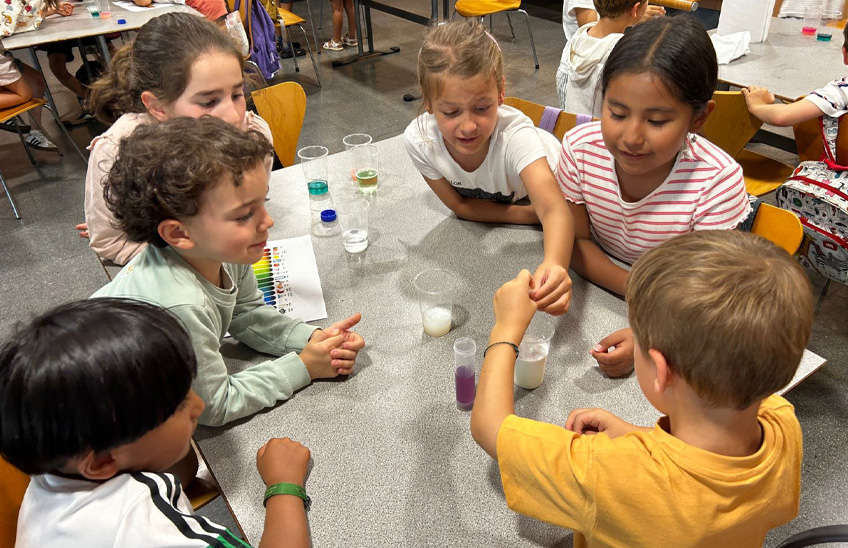
More than 250 boys and girls between the ages of 5 and 11 participated this summer in the “Cienceando” camps organized by the University of Navarra Science Museum. The activities, held on the University of Navarra campus, began on June 22 and ran through August 7, in different weekly sessions.
The program was structured around two activities tailored to the participants’ ages: the nature camp, for boys and girls ages 5 to 7, and the space camp, for children ages 8 to 11. In both cases, the goal was to introduce science in a practical, participatory, and fun way, combining experiments, games, outdoor activities, and teamwork.
At the nature camps, participants explored the world of plants and animals and learned about phenomena such as pollination, birds, insects, and biodiversity. They also conducted physics and chemistry experiments to discover concepts such as surface tension, pH, density, pressure, and center of gravity.
Genetics was also featured with a DNA extraction activity, while electricity and engineering were explored through the construction of electrical circuits, catapults, motorized cars, and small robots. In addition, the children became field biologists to explore the Sadar River, where they analyzed the water and observed its wildlife.
Activities related to pollution, microorganisms, and health also helped participants understand the relationship between the environment and well-being. Throughout the week, participants developed skills such as observation, experimentation, and creativity, in addition to learning to work as a team. The camp concluded with a scavenger hunt through the Science Museum, where they were able to put the knowledge they had gained during the various activities to the test.
In addition, the lunar camps took children ages 8 to 11 on a journey through space exploration. Through experiments, games, and hands-on activities, they learned about the space race and the Apollo missions and discovered how humans came to land on the Moon.
Participants also learned about the daily lives and work of astronauts, explored the International Space Station (ISS), and discovered how spacecraft are designed and what safety measures are required during a mission. As their main challenge, the teams built a model of a lunar base, putting into practice the knowledge they had acquired throughout the week.
The program was rounded out with more recreational activities, such as space-themed recipes—including chocolate rocks and “ant-proof” rolls—and space-themed movement games. In this way, the children combined science, history, creativity, and teamwork to explore some of the major challenges of traveling and working outside Earth.
“Cienceando” are the urban camps organized by the University of Navarra Science Museum, designed for preschool and elementary school students, and they have offered young children a different way to explore science during the summer break, promoting learning through experimentation and active participation. The educational program for these camps was developed by graduates in Biology and Environmental Sciences and in Education and Teacher Training, and the camp counselors are primarily undergraduate students majoring in the sciences and education.


SUBSCRIBE TO THE NEWSLETTER

Enrique Cobos
Head of Communications
ecobos@unav.es
.........