


Opinion
Opinion articles signed by researchers of the BIOMA Institute and the Faculty of Sciences of the University of Navarra.
24/10/2022
Published in
The Conversation
Welcome Leon ?
Researcher at the Institute of Biodiversity and Environment, and professor at the School of Communication of the University of Navarra.
Samuel Negredo
Researcher and professor at the School of Communication of the University of Navarra.
María Carmen Erviti
Researcher and professor at the School of Communication of the University of Navarra.
Climate change, caused primarily by human action, is probably the greatest challenge facing society today. Although its effects are increasingly evident all over the planet - rising temperatures, extreme weather phenomena, desertification, rising sea levels, human migrations, etc. - it is not yet among the main concerns of a large part of society. For this reason, public and private organizations are trying to raise public awareness of the seriousness of the phenomenon and the importance of taking action to try to mitigate its scope.
But communicating climate change is no easy task, due among other reasons to the fact that it is a complex phenomenon, which many perceive as remote from their lives. Moreover, it is a largely invisible process. For this reason, the images used in communicating climate change, whether photographs, graphics or videos, are of particular importance. A research developed by the Research Group on Science Communication of the University of Navarra, recently published by the prestigious British scientific journal Climate Policy, provides four principles for communicating climate change in social networks, through images.
Images of people
Social networks are one of the most popular sources of information on climate change, especially among youth, and the images transmitted through them play a key role in engaging citizens. However, not all images have the same effect.
Some, such as smoking chimneys or a polar bear on a sheet of ice floating on the sea, have become ineffective clichés. Similarly, the images of politicians, businessmen and celebrities, which often illustrate news reports on this subject, do not encourage public involvement.
The study now published analyzes 380 images published on Twitter, within the so-called "top tweets", with the aim of checking which types of images encourage more interactivity from users, in the form of likes, retweets and comments.
The results indicate that images of people achieve higher levels of interaction. On the contrary, those showing the causes of the phenomenon (such as the emission of gases into the atmosphere), or graphics with scientific information, arouse less interest.
 The first principle proposed by the authors of this study is that, among the images of people, those with an image of a person are particularly effective. spontaneous appearancethat is, of not being camera-ready; as well as those showing emotions that seem real. One example is Image 1, which shows a group of Liverpool Football Club supporters in Uganda participating in an action aimed at planting 500 million trees in the region. This photograph obtained 4,162 likes and 955 retweets (Source: @DaveOCKOP).
Storytelling, local connection, and people directly affected
The second principle that helps to encourage user interaction on social networks is that of tell stories. Although a photograph, by itself, is difficult to build a complete story, it can include some of the pillars on which stories are based, such as a protagonist immersed in a conflict.
 Image 2 shows a young Australian woman with her horse. The animal died as a result of the extreme heat and smoke exposure caused by the devastating bushfires in the country in early 2020. The text of the tweet reads: "This is what climate change feels like: it kills". It got 2688 likes and 937 retweets. Photo: @JakelinTroy
The third principle to encourage interactivity with the climate change images posted on social networks is to establish a local connection. As in images 1 and 2, this connection brings climate change closer to people, helping to overcome the traditional perception that it is a remote phenomenon, with no impact on daily life.
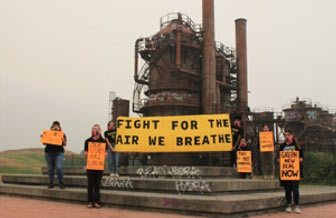 The fourth principle to which the conclusions of this research point to is that of show people directly affectedin images of climate change impacts or actions to combat it. Image 3, published in September 2020, exemplifies this principle: it shows seven women protesting the air pollution caused by the wave of wildfires on the west coast of the USA.
Source: @xnclejessie
These four practical principles are supported by two more general principles: significance and personification. Telling about climate change through images of people and significant events allows this phenomenon to be close and relevant to the public, making it easier to perceive its consequences in one's own life.
These four practical principles, as well as the two more general principles, can be very useful in guiding the visual communication of climate change in social networks, as they help to communicate shared responsibility and facilitate the involvement of citizens in addressing this colossal challenge we all face.
This article was originally published in The Conversation. Read the original.
