News
'Blame' wins Best Documentary at the 7th edition of #LabMeCrazy! Science Film Festival
The University of Navarra Science Museum honors Pedro Miguel Echenique, professor of physics and Prince of Asturias Award winner, with the Passion for Science Award.
24 | 02 | 2026
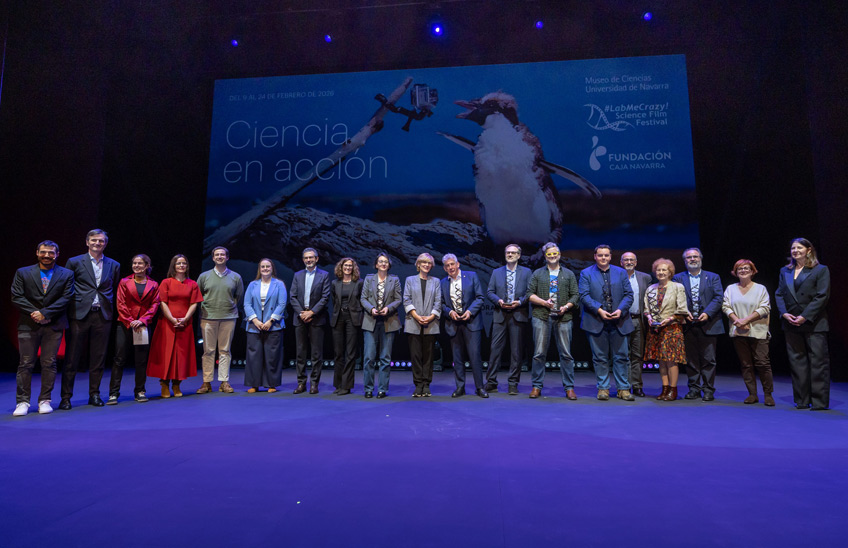
Lights, applause, and an audience that became part of the show. That's how the #LabMeCrazy gala kicked off ! Science Film Festival —the science film competition organized each year by the University of Navarra Science Museum—where more than 600 attendees not only filled their seats, but also voted live, participated in a physics experiment (fluid dynamics), and even pedaled to the beat of the music on a stationary bike while awards and laughter ensued. At the helm were two scientists and comedians from "Big Van Ciencia," Helena González Burón and Oriol Morimon Garrido, who guided an evening that lasted almost two hours and turned the MUN Theater into a laboratory full of science, film, music, and humor.
The award for best documentary went to"Blame,"a Swiss production directed by Christian Frei, which analyzes the COVID-19 pandemic from the perspective of three scientists who had warned in advance about the arrival of a global health crisis. The award for best television program went to the Canadian production "Sweat!" by Take Action Films; the award for best student production went to the British film "Orchids: Darwin's Conundrum"; the award for best work produced by universities and research centers went to "Arctic Shifts" by UCONN School of Fine Arts; while the best video on the web or social media went to the British production "Can You Fight Fires and Diabetes at the Same Time?." In addition, the audience award went to the production "Breathe, Mom." Meanwhile, Pedro Miguel Echenique, professor of physics and winner of the Prince of Asturias Award (1998), was awarded the "Passion for Science" prize.
The awards ceremony was attended by María Iraburu, rector of the University; Eva Perujuániz, Director General of Universities at the Department of Universities, Innovation, and Digital Transformation of the Government of Navarra; Juana García, Vice President of the Caja Navarra Foundation; Maitane Bueno, Director of the Northern Region at Laboral Kutxa; José Antonio Sacristán, Director of the Lilly Foundation; Yolanda Erburu, Director General of the Sanitas Foundation; Javier Andrés Vázquez, Student Representative of the Faculty of Sciences; Bienvenido León, director of the festival; and Ignacio López-Goñi, director of the University of Navarra Science Museum.
The seventh edition of #LabMeCrazy! Science Film Festival received a total of 1,658 entries from 112 countries. The festival has enjoyed the collaboration of the Caja Navarra Foundation and the support of the Spanish Foundation for Science and Technology (FECYT) / Ministry of Science, Innovation, and Universities, theGovernment of Navarra,the SACYR Foundation,Laboral Kutxa, theLilly Foundation, andSanitas.
Throughout February, the University of Navarra Science Museum has organized various scientific activities for all audiences in Pamplona as part of the festival: screenings of films nominated for the Golem Baiona Awards, a family workshop, lectures by scientific experts at Civivox Iturrama, and a discussion for university students with Toby Nowlan, director and producer of "Ocean with David Attenborough" (2025), and a lecture with Pedro Miguel Echenique at the University of Navarra.
Blame, winner of the award for best documentary at #LabMeCrazy!
Christian Frei's Blame immerses viewers in the most tense months of the COVID-19 pandemic, closely following three scientists who had been warning for years that something like this could happen. The film does not remain on the surface of the health crisis: it shows from within how every piece of data, every press conference, and every public statement became a constant tug-of-war between scientific evidence, political pressure, and media noise.
One of the issues that does not go unnoticed by the viewer is seeing researchers grappling not only with science, but also with misinformation, conspiracy theories, and the need to explain complex truths in a world that demands immediate answers. With the pace of a thriller and sustained narrative tension, this film contrasts the patience of the scientific method with the speed of public debate, and leaves a clear conclusion: in a global crisis, the truth also needs defending. As Bienvenido León, director of #LabMeCrazy! Science Film Festival, points out, "Blame" is "a very exciting documentary and thriller" that combines scientific rigor with great storytelling.

SUBSCRIBE TO THE NEWSLETTER

Enrique Cobos
Head of Communications
ecobos@unav.es
.........