
News
María Iraburu, president: “The Bioma Center aims to be a meeting place and a powerful platform for communicating good science more widely and effectively to society.”
The University held a ceremony to lay the “cornerstone” of the project—which will bring together teaching, research, and science outreach—by planting an oak tree
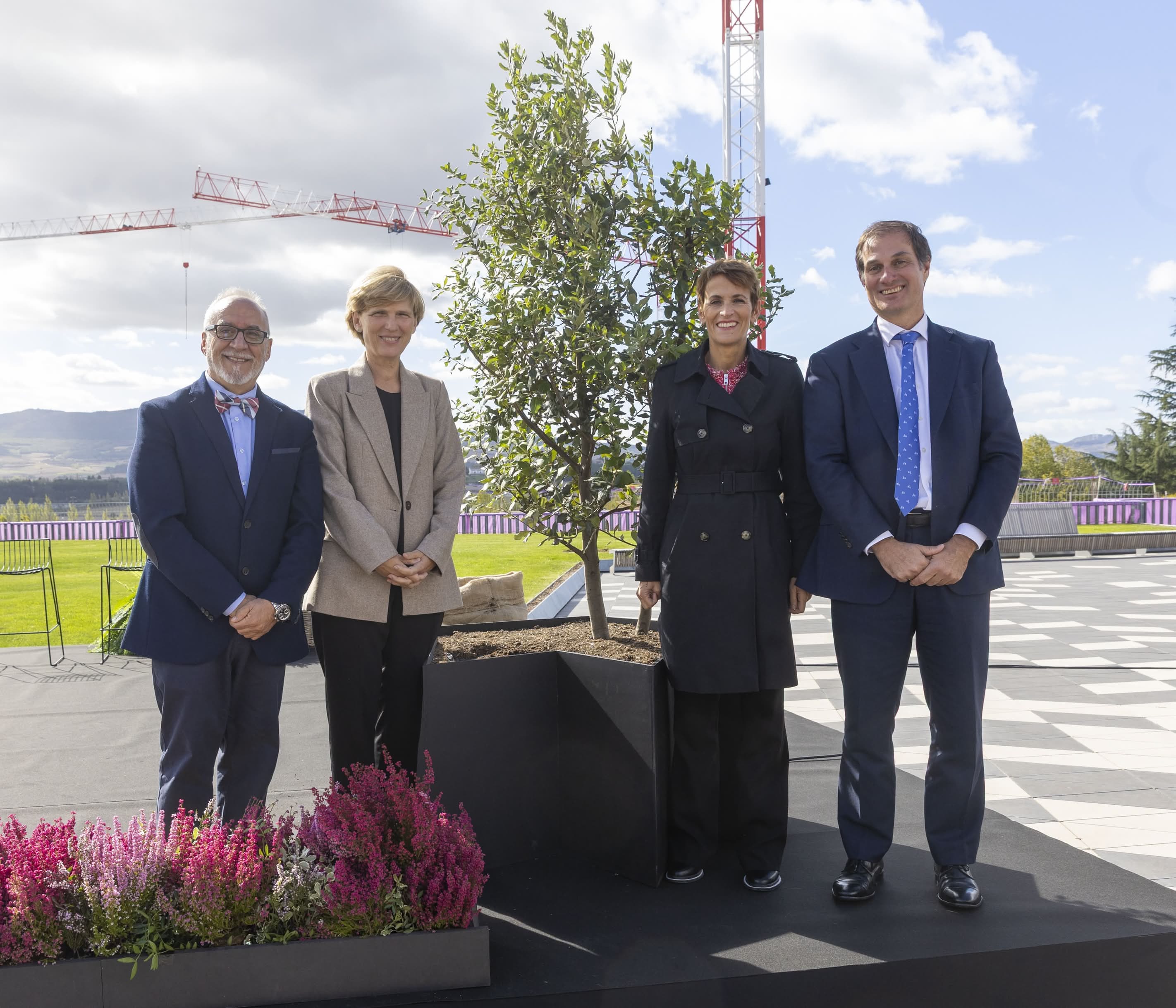
Photo: ManuelCastells/Juan Cruz Cigudosa, Secretary of State for Science, Innovation, and Universities; María Iraburu, president of the University of Navarra; María Chivite, president of the Government of Navarra; and Jesús Mari Ezponda, secretary general of the University.
23 | 10 | 2026
“The Bioma Center aims to be a meeting place and a powerful platform for communicating good science more widely and effectively to society.” With these words , the president of the University of Navarra, María Iraburu, described the Bioma Center, a project currently under construction across from the Cima building and the Acunsa building.
The University of Navarra today celebrated the laying of the “cornerstone” for the building, one of the strategic projects promoted by the university that will house teaching, research, and science outreach activities. The ceremony included the planting of an oak tree, next to which a “time capsule” was buried.
The event was attended by the President of the Government of Navarra, María Chivite; the Secretary of State for Science, Innovation, and Universities, Juan Cruz Cigudosa; the President of the Regional Parliament, Unai Hualde; the Government Delegate in Navarra, Alicia Echeverría; and other representatives from institutions, companies, and donors who have contributed to the project’s funding. The architect Patxi Mangado, the building’s designer, also participated.
The university president presented the Bioma Center as a major forum “for studying, reflecting, debating, and learning about the world we are building” and also as a venue for science outreach: “The University aims to bring specialized research knowledge closer to businesses and the general public.”
Iraburu thenreflected on the significance of the holm oak: “The tree is also a symbol of what the University of Navarra is and aspires to remain through the Bioma Center—a university rooted in this land, to which it has been committed for nearly 75 years, and, at the same time, open to the world, its problems, and its needs. The tree also speaks to us of the future and of growth. The University’s founder, St. Josemaría, said that his mission was to plant trees so that others could enjoy them. And that is what we are celebrating today: we are making possible a project that looks to the future, to the next generations—the students who will be educated here, who will innovate and become entrepreneurs, and the boys and girls who will discover the value of science and the beauty of nature.”
María Iraburu concluded by thanking institutions, companies, and donors for their contributions to the project. “I encourage you to keep dreaming about what we can do at Bioma and through Bioma to serve society.”
The Bioma Center is a space dedicated to teaching, research—particularly that conducted by the BIOMA Institute of Biodiversity and the Environment—and the communication and dissemination of science through the Science Museum. It will also house the facilities of Innovation Factory, the University of Navarra’s Center for Innovation and Entrepreneurship.
Designed by architect Patxi Mangado, the building has a total floor area of 20,000 square meters spread over five levels (two basement levels, ground floor, first floor, and second floor). Construcciones VDR is the contractor awarded the construction project, with a budget of 45 million euros.
Construction began earlier this year with a projected completion time of 28–30 months.
A “Marca Navarra” project
Following a presentation of the project in the Cima auditorium by Patxi Mangado, the “groundbreaking” ceremony continued with a brief roundtable discussion featuring three participants representing the activities that will be centered in the building: research, teaching, and science outreach.
Ignacio López-Goñi, professor and director of the University of Navarra’s Science Museum, described the Bioma Center as a transformative educational project: “This is a university museum based on research. We are the only species capable of destroying the planet, but we are also the only species that, through our work, our science, and our technology, can seek solutions to environmental problems.”
López-Goñi also praised the University’s commitment to Navarra: “This project can only be carried out in Pamplona. Within 100 km of here, virtually all of Europe’s ecosystems are represented: from the Pyrenees mountains to the Bardenas Desert, from the Irati Forest to the Cantabrian coast. That is why this project is also a hallmark of Navarra.”
For her part, Inmaculada Pascual, a researcher at the University of Navarra’s Institute of Biodiversity and Environment (BIOMA) and associate dean of the College of Sciences, noted: “Science can no longer limit itself to diagnosing the planet’s deterioration; its role today is to provide real solutions, based on scientific rigor and applicable to our environment. This is precisely where the BIOMA Institute offers unique value: interdisciplinary research on the environment and sustainability. Environmental challenges do not recognize isolated silos,” she commented.
“For me, living day-to-day with research and scientific culture means understanding that science goes far beyond the laboratory,” said Iria Rodríguez, a senior biochemistry student. She also highlighted what the project means for students at the University of Navarra: “The BIOMA Center is the place where science is researched, shared, and lived. And for us, the students, it’s a unique opportunity to grow as future professionals and also as people.”
An oak tree and a time capsule
Following the symposium, instead of laying the “first stone,” “the first tree” was planted: a 1.5-meter-tall holm oak that will grow next to the building. Once construction is complete, the tree—currently in a pot—will be transplanted to one of the center’s interior gardens. As explained, the choice of this species by researchers at the BIOMA Institute is no coincidence: it combines environmental symbolism, regional identity, and scientific rigor.
In addition, a “time capsule” was prepared and placed in the same pot as the holm oak. Ignacio López-Goñi, Iria Rodríguez, and Inmaculada Pascual have placed inside it an object representative of the year 2026 that they estimate will be obsolete by 2076: a pair of glasses used to view the August 12 eclipse during an activity at the Science Museum, the curriculum of the Faculty of Sciences, and a laboratory tool. Patxi Mangado placed a floor plan of the building in the same time capsule.
Rector María Iraburu, President María Chivite, Secretary of State for Science, Innovation, and Universities Juan Cruz Cigudosa, and the University’s Secretary General, Jesús Mari Ezponda, signed the “foundation stone document, ” which was also placed in the time capsule, along with two copies of that day’s editions of the newspapers Diario de Navarra and Diario de Noticias.
Fundraising and donations
Donors and institutions that have helped fund part of the Bioma Center project were the main attendees at the “groundbreaking” ceremony. As of today, donations have reached 26.1 million (20.6 signed and 5.5 pledged).
Among the companies that have collaborated to date are: the Government of Spain, the Government of Navarre, Atlantic Copper, Koral, Balearia, BBVA, Campus Home, Corporación Hijos de Rivera, Grupo Elecnor, Endesa, Fundación “la Caixa,” Fundación Loro Parque, Grupo Logístico Sesé, Grupo Reifs, Ubesol Group, Laboral Kutxa, RNB Laboratories, Mascato, Cementos Molins, Telefónica, Torreal, Megasa, and Enhol Group.
In addition, the following organizations support and collaborate with the activities of the University of Navarra Science Museum: the Caja Navarra Foundation, as the main partner; ACUNSA Health Insurance; FECYT Innovation; the LILLY Foundation; the SACYR Foundation; and Laboral Kutxa. And the Sanitas Foundation, Cinfa, Timac Agro, and Viscofan support research at the BIOMA Institute for Biodiversity and the Environment.
All information about the BIOMA Center can be found on the website.

SUBSCRIBE TO THE NEWSLETTER

Enrique Cobos
Head of Communications
ecobos@unav.es
.........