News
Carlos Briones of the CSIC: "From a scientific standpoint, we are optimistic that other forms of life may exist in the universe."
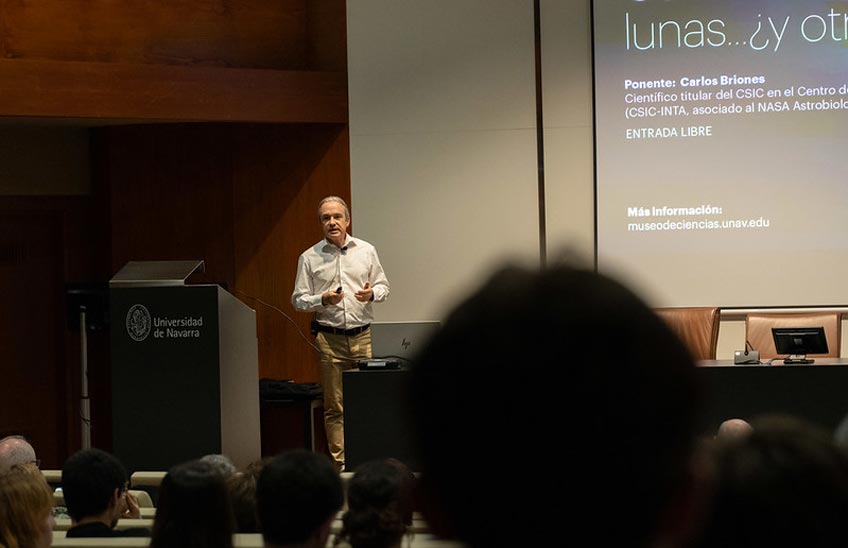
The first session of the series “Other Suns, Worlds, Moons… and Other Forms of Life?”, organized by the University of Navarra Science Museum, drew a crowd of 145 people to the auditorium in the university’s Science Building
23 | 04 | 2026
The Science Museum has launched“Mondays in the Sun,”a series of talks with experts designed to prepare the public—from historical, philosophical, and scientific perspectives—for the total solar eclipse that will take place on August 12.
Carlos Briones, a scientist at the CSIC’s Center for Astrobiology, was the keynote speaker tasked with opening the series, and he began the session by posing a few questions: Are we alone in the universe? Could intelligent beings exist on other planets?
For Briones, science and technology have made the range of possibilities regarding these historical questions “enormous.” Briones highlighted one of the major milestones in astronomy: the discovery of the first exoplanet in 1995 by Swiss astronomers Michel Mayor and Didier Queloz, a finding that transformed modern astronomy. “Since 1995, more than 6,000 exoplanetshave been discovered.”
In an effort to answer those questions, the scientist from Burgos has put together an informative scientific presentation. He highlighted the six elements essential for life that appear on the Periodic Table and form the chemical basis of biomolecules: carbon, hydrogen, oxygen, nitrogen, phosphorus, and sulfur.
Astrobiology posits that if life exists beyond Earth, it would have to be based on carbon (because it is the element that forms the strongest bonds) and water ( because it is the best solvent), although its constituent molecules would not necessarily have the same biochemical structure. In this regard, scientists are searching for biomarkers (molecules produced by living organisms) on other planets to determine whether life could exist beyond Earth. Briones has ruled out oxygen, ozone, methane, phosphine, dimethyl sulfide, amino acids, nucleobases, ribose, and glucose as biomarkers, even though these molecules have been found in the cosmos and in other planetary systems. “We have even found molecules that we know can form biologically but that have also been shown to form chemically, through other pathways,” he added.
Carlos Briones says that we don’t know if there is life on other planets, although there is scientific optimism, and that “if there are other forms of life, they may be different because their biochemical composition is very different.” According to the scientist:“Mathematics, physics, geology, and chemistry tell us that there may be something similar in other places like Earth.”
The CSIC researcher concluded his talk with a brief overview of the studies and space missions conducted on Mars, Jupiter, and Saturn, as well as on their moons Europa and Titan.
The next event in the series will be the lecture“Looking Up at the Sky: Mathematics and Philosophy of the Ancient Celestial Spheres,”presented by Paloma Pérez-Ilzarbe and Diego Maza, professors at the University of Navarra. The event will take place on Monday, April 27, at 7:00 p.m. in the Civican Auditorium (Avda. Pio XII, 2, Pamplona).

SUBSCRIBE TO THE NEWSLETTER

Enrique Cobos
Head of Communications
ecobos@unav.es
.........