News
Ethical management of invasive species and emerging diseases to be debated at the 6th National Congress
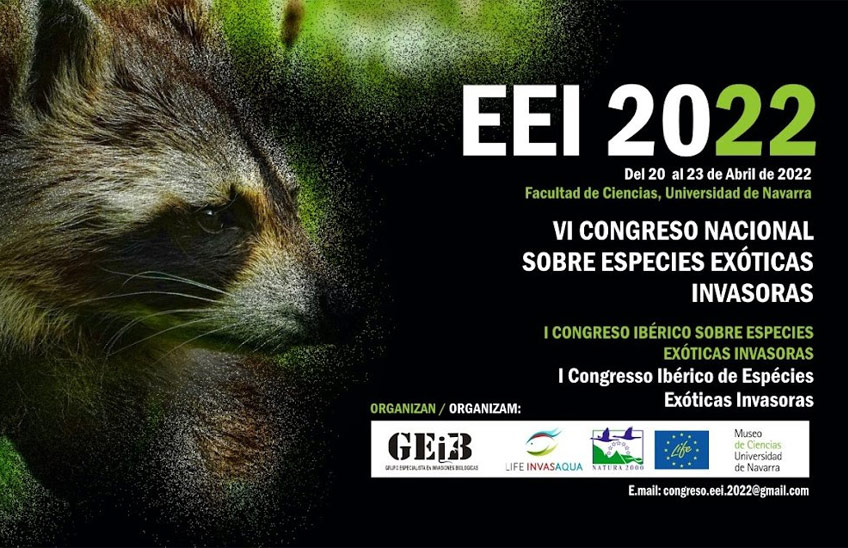
The University of Navarra will host from April 20 to 23 the VI National Congress on Invasive Alien Species (IAS), where experts will discuss the advances and challenges posed by biological invasions.
21 | 04 | 2022
The meeting, organized by the Biological Invasions Specialist Group (GEIB), in collaboration with the University of Navarra and the Life Invasaqua program, will bring together 160 participants and more than a hundred papers.
The objective is to share the efforts made to deal with biological invasions, which have multiplied in recent years, and to make progress both in their management and in the restoration of damaged native biodiversity, according to Laura Capdevila-Argüelles, coordinator of the congress and of the GEIB.
This problem affects all territorial areas (local, regional and national) and multiple initiatives are being developed by different institutions and entities (administrations, universities, companies, NGOs) to address it. Therefore, it is important to share progress and failures, discuss future needs or set priorities, he stressed.
This edition will focus on aquatic invasive species, emerging diseases related to the introduction of IAS in Europe that affect both humans and wildlife, and how to manage this problem in an ethical manner. Among the emerging diseases, cases such as the chikungunya virus, which appeared in Europe with the arrival of the tiger mosquito, or the baylisascaris parasite, derived from the introduction of the raccoon, will be analyzed. Both cause encephalitis in humans.
What to do with the animals and plants that unintentionally invade us will be another of the issues to be debated, since, in the public eye, it is very important to seek mechanisms that take ethics into account and that, at the same time, make it possible to put an end to the problem of invasive species. "Invasive alien species have become one of the greatest threats to biodiversity and have a strong impact on our economies. It is a global problem that must be tackled globally," said Rafael Miranda, researcher at the Institute of Biodiversity and Environment of the University of Navarra and member of the European LifeInvasaqua project.
For this reason, the congress will bring together "scientists, managers, administrations and other entities in order to share our knowledge and experiences, and thus advance in decision-making," he added.
On this occasion, the event, which is held every three years, will have the special participation of the European Life Invasaqua project on invasive alien species in freshwater and estuarine systems, co-funded by the European Union to advance awareness and training on IAS in Spain and Portugal.

SUBSCRIBE TO THE NEWSLETTER

Enrique Cobos
Head of Communications
ecobos@unav.es
.........