
News
"Changes in agricultural practices have caused variations in owl populations in Navarre over the last 25 years."
University research indicates that there have been changes in the distribution patterns of this species.
19 | 10 | 2021
The barn owl is no longer in the same places in Navarra as it was 25 years ago. A study carried out at the Faculty of Science of the University of Navarra indicates that changes in agricultural practices, such as the abandonment of barns and corrals -the usual place where these species nest- and the commitment to industrial buildings as the current model of construction in the fields, are relevant aspects that are causing the gradual disappearance of this species in the Comunidad Foral.
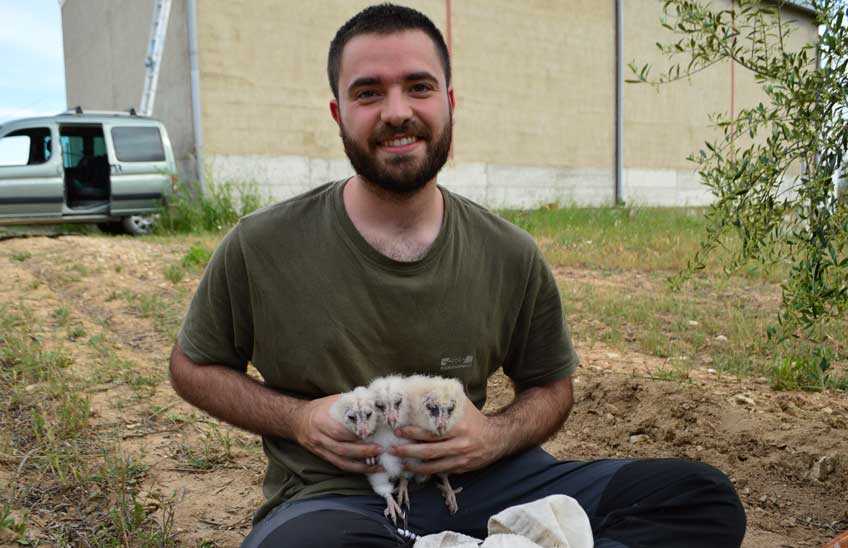
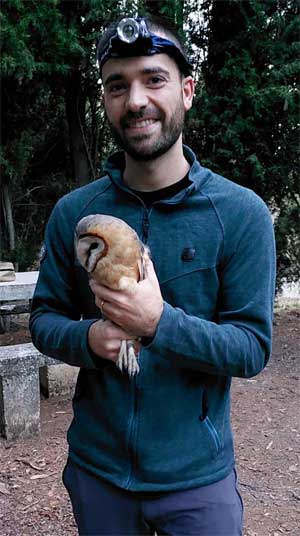 These are some of the conclusions derived from the research carried out by Dr. Rubén Hernández Soto (Cárcar, 32 years old) and which have been reflected in his doctoral thesis entitled "Barn Owl (Tyto alba): influence of captive breeding on its adult behavior and indirect assessment of its population evolution in Navarra.".
According to Hernández Soto, there is a consensus in the scientific community that links the change in land use, land consolidation, the use of pesticides, and the disappearance of the usual nesting sites with the decline of owl populations in recent decades, making it necessary to reintroduce these species - bred in captivity - into the natural environment.
The study carried out by this biologist has focused on mapping the location of the barn owl in Navarra by locating pellets - which are "a kind of oval-shaped "balls" composed of the caked remains of the hair and bones of their prey, which are separated from the meat in the digestive tract and regurgitated by the birds" - and comparing these data with others collected in a study carried out in the 1990s.
In addition, Hernandez has conducted interviews with farmers and hunters who reside in the areas where sampling has been conducted, to get their opinion on whether there are fewer owls than before. "Our research makes it clear that there has been a change in owl populations and that changes in agricultural practices have generated it."
As part of the same research, Dr. Hernández has studied the behavior of more than 60 specimens of this species - owls bred in captivity with different degrees of contact with humans - to learn about the behavioral changes these animals undergo in familiar or unfamiliar situations, as well as how they learn to hunt. "Our results show that owls raised with greater contact with humans are less fearful of new environments and situations than owls with greater contact with their biological parents. The latter, on the other hand, show greater anti-predator behavior," he adds.
Rubén believes that this research should continue with the captive breeding of owls and their release into the environment, in order to learn about the adaptive capacity of these species. "It is necessary to carry out practical experimentation in the field in order to observe whether the results obtained in captive experiments correspond to the behavior and adaptation that individuals show once they are in the wild and must survive in the natural environment."
The barn owl(Tyto alba) is a nocturnal bird of prey, predator of micromammals such as mice, voles or shrews, adapted to flying in open spaces and with a preference for nesting in barns or corrals. "The owl functions as an excellent biological controller of micromammal pests in agriculture, keeping rodent populations at low levels and greatly reducing the importance of periodic population peaks," he adds.
Rubén Hernández Soto has a degree in Biology from the Faculty of Sciences of the University of Navarra and has completed his PhD in the Department of Environmental Biology under the direction of Professors David Galicia and Enrique Baquero.

SUBSCRIBE TO THE NEWSLETTER

Enrique Cobos
Head of Communications
ecobos@unav.es
.........