News
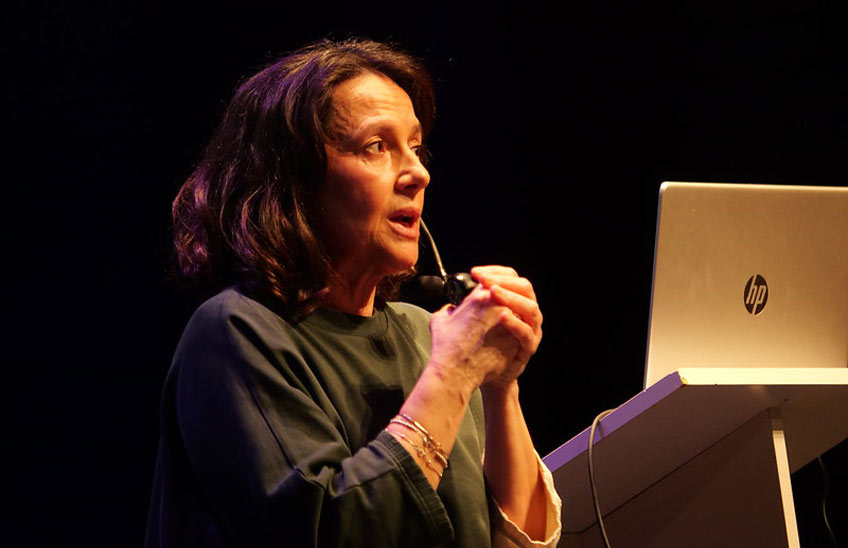
Gloria González, researcher at Cima: "If a treatment saves a life, no amount of money in the world can pay for it."
Yesterday, around fifty people attended a session on rare diseases as part of the #LabMeCrazy science film festival!
18 | 02 | 2026
Noah is a 26-year-old woman who suffers from seven rare and incurable diseases. Since her first year of life, she has undergone numerous operations, medical tests, and hospital admissions. This Wednesday at 7 p.m. at the Golem Baiona cinemas, the film"Noah"will be screened, a Spanish documentary that tells the story of this young woman who has turned her story into a message of resilience and hope.
Yesterday afternoon, at Civivox in Iturrama, his story came to light. Gloria González Aseguinolaza, professor at the Faculty of Medicine and researcher at Cima University of Navarra, gave a lecture entitled"Rare diseases: The answer lies in our genes,"and referred to one of the diseases Noah suffers from, which is genetic in origin.
At the beginning of the talk, the researcher gave an informative explanation of DNA and how this molecule is responsible for making us all different from one another. To frame her speech, she spoke about Mendel's inheritance and peas, and about the pus on surgical gauze, fruit flies, and bread mold as examples of organisms or biological materials used as models for study in genetics, microbiology, and biomedicine.
She also highlighted the Human Genome Project (1990-2003), which was a milestone for medicine, as it succeeded in deciphering the complete sequence of human DNA (3 billion chemical "letters" and between 20,000 and 25,000 proteins that form our biological basis). For Gloria, technology has now evolved at breakneck speed. "For example, although it took years and many research groups to sequence the first human genome, it now takes only days and is done by a single laboratory."
Thanks to the international Human Genome Project, it became clear that variations in DNA can be associated with the cause of a disease. "A modification in DNA that alters the structure or function of a protein can cause a disease."
The researcher pointed out that there are more than 300 million people affected by rare diseases and more than 7,000 different genetic diseases, and that some of them, if treated in time, such as spinal muscular atrophy, can improve people's lives. The scientist pointed out that it is possible to manipulate DNA through the use of molecular tools obtained from bacteria, which allow laboratories to "artificially create DNA with new information." The speaker added that viruses can be excellent vehicles for gene therapy, as they can enter cells and introduce genetic material: "once inside, the genetic material can be used by the cell to produce therapeutic proteins." For Gloria, "the problem with these diseases is that sometimes palliative treatments, physical therapy, or stimulation are necessary to improve quality of life," unlike other diseases, such as those of bacterial or tumor origin, where it is possible to apply more targeted therapy.
The biologist from Hondarribia said that institutional support is needed to finance these treatments, which are very expensive per patient. "We need to improve production systems and then transfer them to those who produce on a large scale. It's going to be a team effort. It's very expensive, but no more expensive than a life. If a treatment saves a life, no amount of money in the world can pay for it."
#LabMeCrazy! Science Film Festival is an international science film competition organized by the University of Navarra Science Museum, in collaboration with the Caja Navarra Foundation and with the support of the Spanish Foundation for Science and Technology (FECYT) / Ministry of Science, Innovation, and Universities, the Government of Navarra, the SACYR Foundation, Laboral Kutxa, the Lilly Foundation, and Sanitas.


SUBSCRIBE TO THE NEWSLETTER

Enrique Cobos
Head of Communications
ecobos@unav.es
.........