News
"Science in White and Red," a different way to experience the Sanfermines
The University of Navarra Science Museum is presenting this project to explain the science behind the San Fermín festival
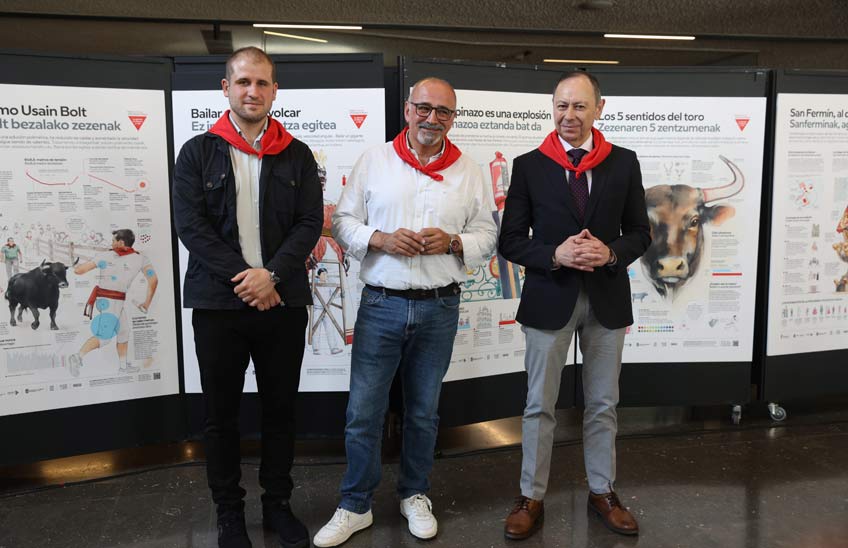
Photo: ManuelCastells/Carlos Andrés Uranga, from the Pamplona City Council; Ignacio López-Goñi, director of the University of Navarra Science Museum; and José Ángel Andrés, president of the Caja Navarra Foundation.
16 | 06 | 2026
At what height does the opening firework go off? How many people can fit in the square on July 6? What was Pamplona like during the time of San Fermín? Can a giant figure be toppled? Why are some fireworks red and others green? Is the bull run faster than it used to be? Why does the music of San Fermín move us so much? Did you know that bulls don’t have horns, they have antlers? And that they can’t see the color red? Where did Hemingway write “The Sun Also Rises”?
The San Fermín “chupinazo” is not only the symbolic start of the festival, but also a chemistry experiment right in the Town Hall Square. The rocket contains about 25 grams of black powder, a mixture of potassium nitrate (75%), charcoal (15%), and sulfur (10%). When ignited, the sulfur and charcoal burn rapidly using the oxygen provided by the potassium nitrate. This combustion produces a large amount of gases which, as they are expelled downward, and according to Newton’s principle of action and reaction, generate the force that propels the rocket upward until it reaches between 500 and 1,000 meters. At the moment of detonation, it reaches a sound level of 133 decibels, similar to the noise of an airplane taking off.
“Science in White and Red” is an initiative to disseminate and promote scientific culture by exploring the science behind the San Fermín Festival in Pamplona. It consists of a collection of nine large-format posters (scientific infographics) that explain, in a visual, entertaining, and accessible way, the science, technology, history, and interesting facts behind the objects, themes, and key figures of the San Fermín Festival. The collection, available in Spanish and Basque, will be on display at various locations throughout the city from June 16 to July 14.
It is aimed at the general public to highlight the science behind the most everyday aspects of the city’s patron saint festivities: the chupinazo is an explosion, San Fermín revealed, bulls like Usain Bolt, dancing to stay upright, fireworks are a matter of chemistry, the bull’s five senses, music that touches the soul, and the human tide in the Town Hall Square.
During the presentation, Ignacio López-Goñi, director of the University of Navarra Science Museum, emphasized that “since this year marks the centennial of the novel *The Sun Also Rises*, Hemingway is not only the subject of one of the posters, but he is also mentioned in each of the themes. In addition, in developing this project, we have benefited from the guidance of a team of professionals including chemists, biologists, physicists, historians, archaeologists, designers, illustrators, and other experts.”
For his part, José Ángel Andrés, president of the Caja Navarra Foundation, emphasized that the partnership with “Science in White and Red” stems from “the conviction that alliances are necessary to drive initiatives with greater impact and quality.” In his remarks, he noted that “collaborating means multiplying possibilities and capabilities in the service of society,” and emphasized that this project demonstrates that “science is everywhere, even at a festival as iconic as San Fermín.” José Ángel Andrés congratulated the University of Navarra Science Museum for “its innovative vision and its ability to bring knowledge to the public through familiar, recognizable elements that are deeply connected to our reality.”
In addition, the University of Navarra Science Museum has set up a project website where you can find more information about each infographic.
This project is an initiative of the University of Navarra Science Museum in collaboration with the Caja Navarra Foundation, the Spanish Foundation for Science and Technology (FECYT) / Ministry of Science, Innovation, and Universities, the City of Pamplona, Diario de Navarra, Cadena SER, and the Navarre Hospitality and Tourism Association.

SUBSCRIBE TO THE NEWSLETTER

Enrique Cobos
Head of Communications
ecobos@unav.es
.........