
News
The Science Museum of the University of Navarra brings to Spain the exhibition "Dinosaurs Among Us".
The exhibit, created by the American Museum of Natural History (New York), will remain at the University's Science Building from October 6 to November 25.
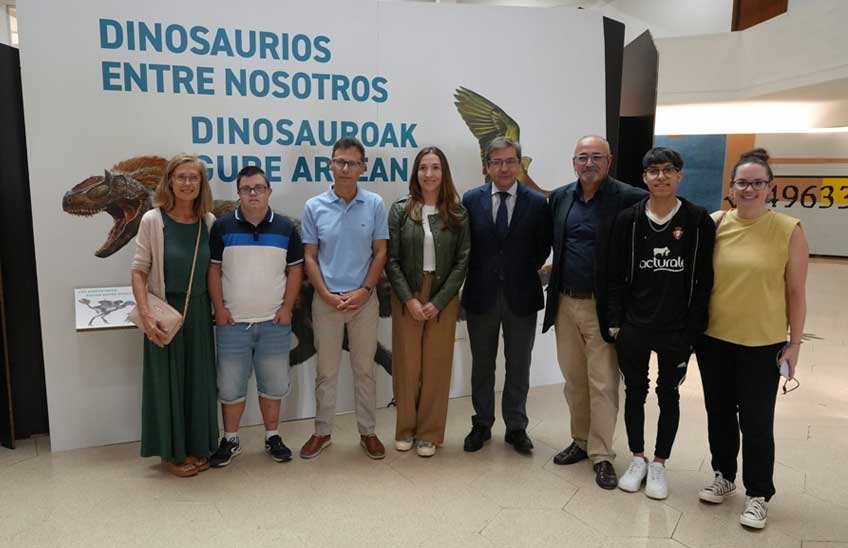
FotoManuel Castells<br>/(de izquierda a derecha): Elvira Lacunza (directora educativa del Centro de Educación Especial El Molino), Alejandro Alzugaray (alumno del Centro de Educación Especial El Molino), Fidel Torcida (director del Museo de Dinosaurios de Salas de los Infantes), Alejandra Castellanos (gerente de desarrollo estratégico del departamento de desarrollo global del Museo Americano de Historia Natural de Nueva York), Carlos Salvador (concejal de Educación, Igualdad y Diversidad Cultural del Ayuntamiento de Pamplona), Ignacio López-Goñi (director del Museo de Ciencias Universidad de Navarra), Lino Valero (alumno del Centro de Educación Especial El Molino) y Natalia Galban (docente del Centro de Educación Especial El Molino).
05 | 10 | 2023
The next time you dodge a pigeon on the sidewalk, see a sparrow eating on a patio or order chicken for dinner, know that you' ve just encountered a modern dinosaur. Dinosaurs didn't really disappear from Earth because, although most became extinct, their evolutionary legacy lives on today through birds.
The Museo de Ciencias Universidad de Navarra brings to Spain the exhibition "Dinosaurs Among Us", an exhibit created by the American Museum of Natural History (New York) that explains the uninterrupted connection between modern birds and the dinosaurs that dominated the planet for 170 million years. The panels feature large-scale color illustrations of extinct and recently discovered dinosaur species presented as they would have looked in real life.
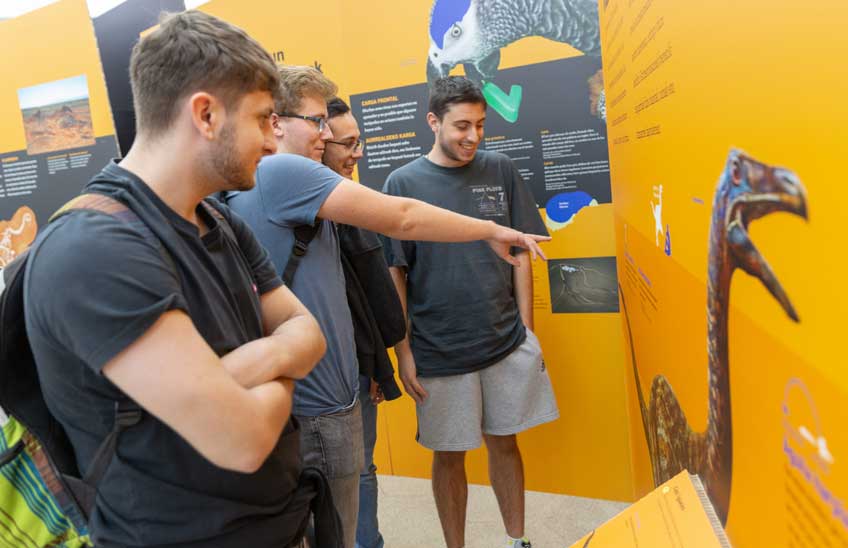
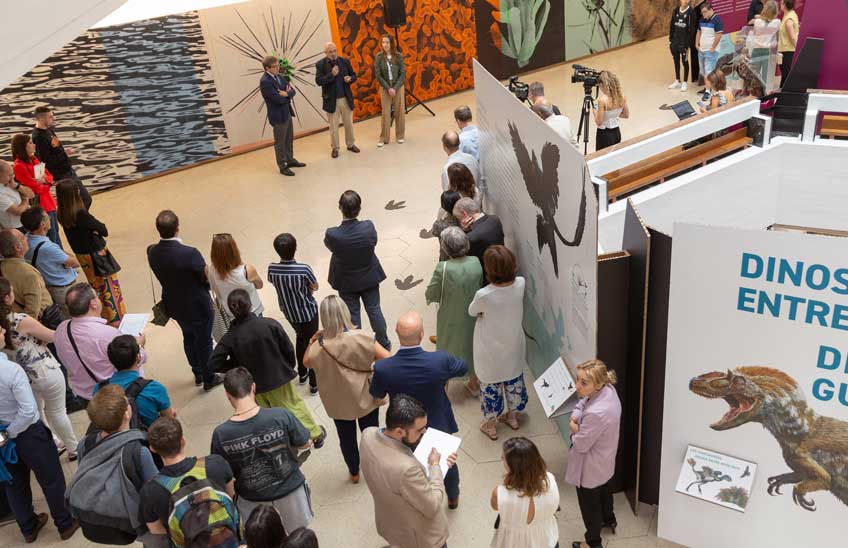
The exhibition can be visited free of charge at the Science Building of the University of Navarra from October 6 to November 25, from Monday to Friday from 9 am to 8 pm and on Saturdays from 9 am to 2 pm. School visits will take place from Monday to Friday from 9 a.m. to 1 p.m. with prior registration.
On the other hand, the Science Museum of the University of Navarra has organized various activities for all audiences around this theme, such as talks with experts, family workshops and a training program for schools, which can be consulted on its website.
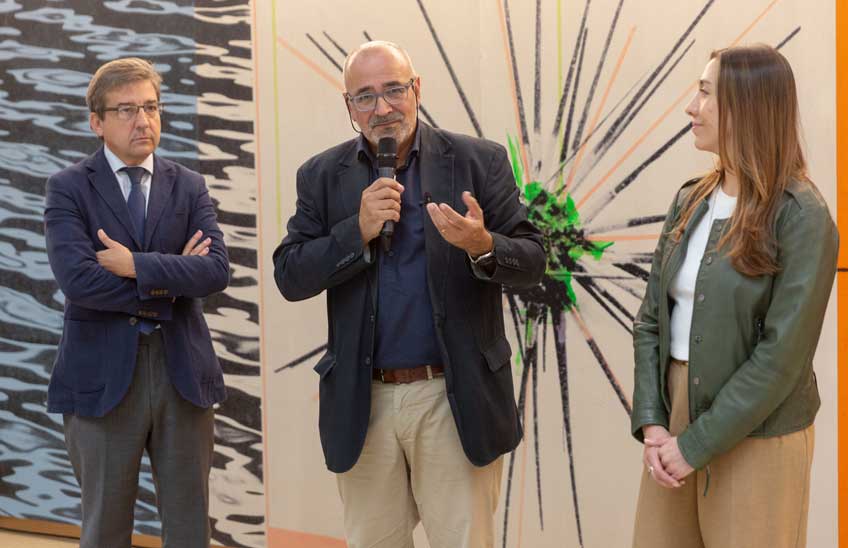
"The exhibition is part of a broader initiative that seeks to foster a scientific conversation at various levels. We have organized training for teachers and teacher training students, workshops for schools, open lectures covering topics ranging from Darwin and Evolution to Geology and Paleontology. We are especially pleased with the collaboration of the students of the El Molino school who have helped us with the adapted posters and the Dinosaur Museum of Salas de Infantes who have donated fossils from their collection to enrich the visit", explains Marie-anne Reynell, Director of Development of the Science Museum of the University of Navarra.
Modern birds are dinosaurs living among us
"Dinosaurs Among Us" probes the boundary that exists between the animals we call "birds" and those we traditionally know as "dinosaurs." Living birds belong to a group called "Dinosauria" that includes extinct dinosaurs and all of their living descendants, which is why most scientists have come to the consensus that birds are a species of dinosaur just as we are a species of mammal. When looking at the paleontological and biological evidence, the public can appreciate the links between dinosaurs and birds, as well as when looking at their reproduction, their physical structures and the evolution of their flight, proving that birds are indeed dinosaurs living among us.
"Dinosaurs Among Us" is organized by the American Museum of Natural History in New York with the support of the North Museum of Nature and Science (USA), the Philip J. Currie Museum (Canada), the Museo de Ciencias Universidad de Navarra (Spain), and the Universum Museo de las Ciencias de la UNAM (Mexico). The exhibition in Pamplona has been sponsored by Pamplona City Council, the Spanish Foundation for Science and Technology (FECYT) / Ministry of Science and Innovation, Acunsa and Caja Rural de Navarra, as well as the collaboration of the Ciganda Ferrer Foundation-Colegio El Molino School and the Dinosaur Museum of Salas de los Infantes (Burgos).
This edition of the exhibition is curated by Dr. Akinobu Watanabe, research associate at the American Museum of Natural History and assistant professor of anatomy at the New York Institute of Technology. It is an adaptation of an original Museum exhibit of the same name curated by Mark Norell, curator emeritus of the Department of Paleontology.
The American Museum of Natural History, founded in 1869 with a dual mission of scientific research and science education, is one of the world's foremost scientific, educational and cultural institutions. The museum encompasses more than 40 permanent exhibition halls, galleries for temporary exhibitions, the Rose Center for Earth and Space which includes the Hayden Planetarium, and the Richard Gilder Center for Science, Education and Innovation.
The museum's scientists draw on a world-class permanent collection that includes more than 34 million specimens and artifacts, some of which are billions of years old, and one of the largest natural history libraries in the world. Through its Richard Gilder Graduate School, the museum offers two independent degree-granting programs unique to any museum in the United States: the Ph.D. program in Comparative Biology and the Master of Arts in Teaching (MAT) program with an emphasis in Earth Sciences. For more information, you can visit their website at amnh.org.

SUBSCRIBE TO THE NEWSLETTER

Enrique Cobos
Head of Communications
ecobos@unav.es
.........